
 AIM EngineCREATE · AUTOMATE · AMPLIFY
A collection of academic citations is not yet an evidence base. The useful step is identifying what each paper supports, recording the limits of that finding and connecting it to a specific analytical question.
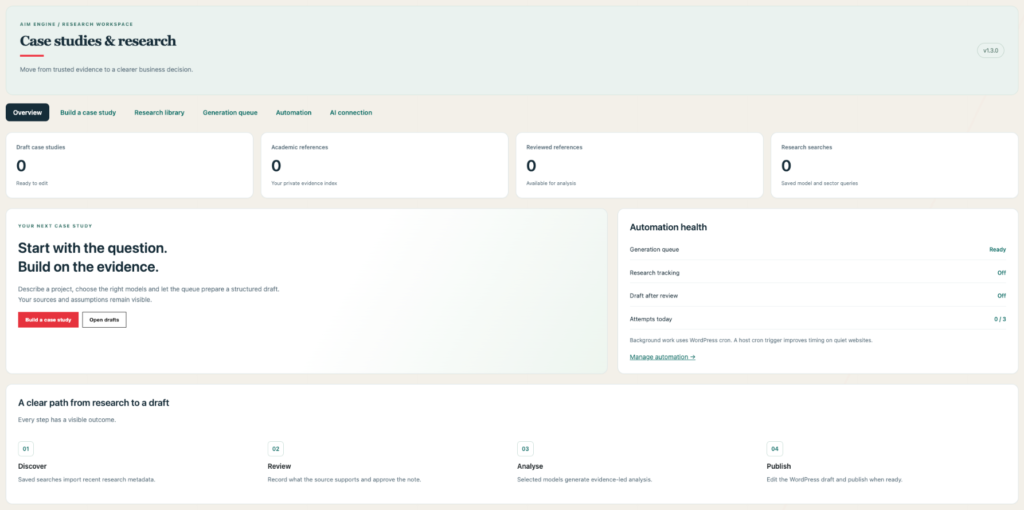
AIM Case Study & Research Library brings that workflow into WordPress. Its private academic reference index connects to Crossref and OpenAlex, organises records by analysis model, research category and label, and lets administrators attach reviewed evidence notes to case-study briefs. For educators, consultants and research teams, the distinction between discovering a record and approving evidence is central to using the software responsibly.
Begin with a research question, not an accumulation target
The library can add default research searches for all 15 supported analysis models or use sector-specific searches. A useful starting point is a narrow question connected to an upcoming analysis. Searching for material relevant to a stakeholder question, for example, creates a clearer review task than collecting broadly related publications without an intended use.
The plugin supports up to 30 saved searches. Each search can have a configurable publication window; the default covers the last 90 publication days. That makes the tracker useful for watching recent publications, but recent work is not automatically the most relevant evidence for every question.
A practical recommendation is to distinguish two needs: monitoring new material and identifying the evidence needed for a particular case study. A recent-publication search can support the first. The second still requires judgement about relevance, context and whether the available material answers the question.
Understand what retrieval does and does not establish
Each search run can retrieve up to 25 newest matches per provider. Bibliographic records retain available authors, publication dates, journal or venue details, DOI links and provider information. References with matching DOI identifiers can be merged across providers; title and year provide a fallback when a DOI is unavailable.
These capabilities help organise discovery, but the limits matter:
- Retrieval does not provide exhaustive research coverage.
- Publication metadata does not establish that a paper supports your proposed claim.
- The tracker does not download paywalled papers.
- Findings are not automatically verified.
- Access and limits depend on the external research services.
Duplicate matching can help keep the index orderly. It does not assess the quality of a study or resolve differences between findings. A well-organised record remains a discovery aid until someone reviews the underlying work.
Make the evidence note the point of accountability
Papers remain unreviewed until an administrator records and approves an evidence note. This gives the workflow a meaningful checkpoint between finding a publication and using it in AI-generated analysis.
A recommended review process is to read the relevant material, identify the finding it actually supports and record enough context to prevent an overbroad interpretation. Where the evidence applies only to a particular setting or population, the note should preserve that boundary rather than turn it into a universal statement.
Hypothetical example: a stakeholder analysis
Suppose an educator is preparing a business case study involving stakeholder participation. A search returns a paper that appears relevant. After reviewing it, the administrator records a note explaining the finding supported by that paper and the context in which it was observed.
The reviewed note can then be attached to the case-study brief. It may inform a question or recommendation in the stakeholder analysis, but it does not prove that the same outcome will occur in the project being examined. Project-specific evidence and analytical assumptions still need to remain distinct.
Organise references for reuse without losing context
Model assignments, research categories and labels provide ways to organise the private index. A practical approach is to use labels consistently enough that another reviewer can understand why a reference belongs with a particular analysis.
That consistency also matters for generation. The plugin can automatically attach up to five reviewed references matching selected model labels. Alternatively, the generation form allows selection of up to 15 reviewed academic references, within a total limit of 25 combined manual and academic sources.
Automatic matching is a convenience, not a relevance verdict. Before generation, check whether the selected notes address the current brief and whether their scope has been preserved. More references do not necessarily produce a better-supported argument if they are only loosely connected to the question.
Choose a monitoring cadence your team can review
Research checks can be run manually or through optional WordPress scheduling. The scheduled process runs hourly and processes one due search; each search becomes due after 24 hours. Actual checks depend on WordPress cron and site traffic, so this should not be described as a guaranteed real-time feed.
Manual checking may suit an occasional research task. Scheduling may suit an ongoing watch list, provided someone is responsible for reviewing the records it discovers. Adding searches without review capacity can create a larger unreviewed collection rather than a more useful evidence base.
Move from reviewed evidence to an editable draft
Once relevant notes are approved, they can support a focused model report or a combined case-study draft. Optional automation can also queue an analysis after evidence review using a saved application brief; it is disabled by default.
The next step is to test one complete chain: a focused search, a reviewed paper, a carefully bounded evidence note and a draft that uses it appropriately. AIM Case Study & Research Library connects those stages, but does not replace reading, critical appraisal or editorial responsibility. All generated claims and references require review before manual publication.
AIM Tools promotional article. Explore AIM Case Study & Research Library and membership access.
Help shape the next version
Share a question, experience or useful evidence about this article. Responses are held privately for editorial review, not published as testimonials.
Add an example, conclusion or question.
Short, specific responses help AIM Community improve future articles and product decisions.